Nature as a powerful solution for urban flood risk
Topic: Flood resilience and green space
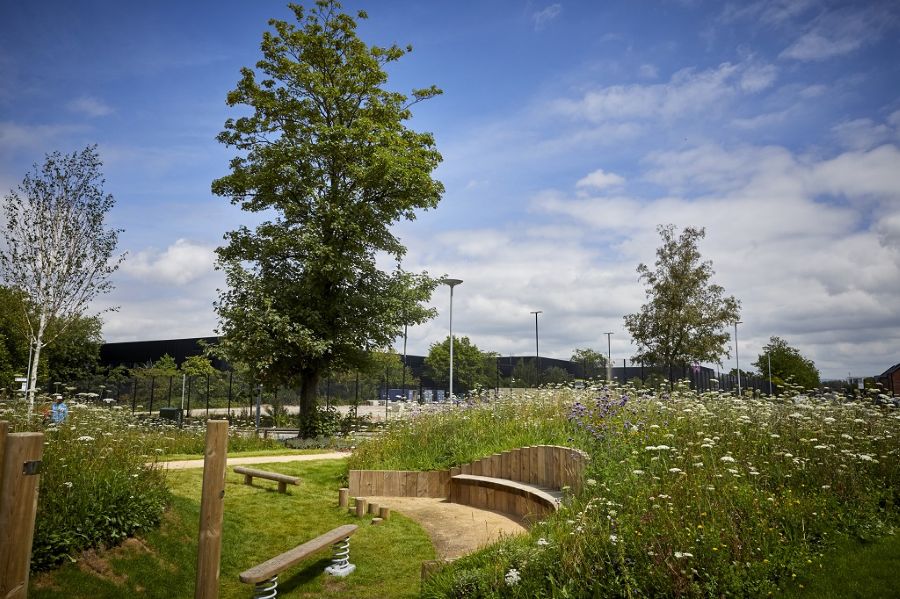
Image: BDP and Groundwork
West Gorton’s ‘sponge’ park has informed the design of green spaces in flood-prone areas across Europe. Its nature-based sustainable drainage systems ‘drink’ water. And proved the vital role of green infrastructure in urban design. Not only in its management of storm water. But also, for urban resilience and liveability.
Surface water caused by heavy rainfall is one of the main flood risks in Manchester. The city’s hard urban environment adds to the problem. And, as the climate changes, extreme weather is becoming more frequent and intense. Making flood resilience a key consideration for our built and natural environments.
Data from the park and sewers shows how well sustainable drainage can manage runoff. Green spaces of all types and sizes can play a key role. They reduce flood risk, connect and cool our neighbourhoods and improve air quality. As well as boosting biodiversity and the health and wellbeing of local communities.
Urban flooding
Urban flooding is a challenge in towns and cities across the UK and Europe. Roads, buildings and other hard surfaces leave few areas for water to drain naturally. As a result, heavy or prolonged rain can exceed the capacity of sewers. A perfect storm for a climate that’s getting wetter.
Parks and other green spaces offer a way to tackle flooding and other climate risks. Careful design with effective sustainable drainage can grow their capacity. Allowing them to ‘drink’ large volumes of storm water. So they act as a ‘sponge’. To protect both the built and natural environment.
What is sustainable drainage?
Sustainable drainage systems (SuDS) mimic nature to manage surface water. They can direct, slow and store water. Usually, by letting it soak into the ground close to where it falls. SuDS can also enhance biodiversity and the natural environment. As a rule, they cause no long-term damage, improve habitats, reuse water and protect its quality.
Sustainable drainage design often uses a series of tactics. Such as:
- permeable paving – that allows water to pass through it
- green roofs – with plants that absorb and reuse rain
- rain gardens – plants and mulch that capture and filter runoff
- swales – like raingardens with channels to move water
- soakaways – gravel-filled pits that allow water to drain into the ground
- bioretention tree pits – that absorb water to slow and filter runoff
- detention ponds – that store storm water and release it slowly into the ground
West Gorton's 'sponge' park
West Gorton’s 'sponge' park absorbs storm water to reduce pressure on sewers. First funded in 2017, by the EU’s GrowGreen project, it piloted climate adaptation methods. And helped us to assess the benefits of nature-based solutions. The park has meadow, woodland and community space. A mix of swales, rain gardens, permeable paving and bioretention tree pits are key to their design.
These systems, monitored by the University of Manchester, are very effective. Over two years, the average volume of water going into nearby drains reduced by 96.6%. The volume of average peak flows reduced by 99.5%. A huge reduction in an area that was a flood risk.
Reduced flood risk wasn’t the only success. Other benefits are:
- better water quality
- more biodiversity
- better protection from extreme heat
- more community use and more active lifestyles
The increased number and type of trees, shrubs and smaller plants improved biodiversity. As well as the quality of habitats. The plants also help to filter toxins from the air and the tree canopy provides shelter from the sun. And they make an attractive place for people to get out in nature.
Increased social activity in the park is a boost for the health and wellbeing of locals. Spending even short amounts of time in nature has proven health benefits. More people, of all ages, use the park now. To walk and interact. Locals helped to design it and it hosts community events.
The park demonstrates the key role of nature for health and climate. Partners – such as Defra and the Environment Agency – have used it to inform their practice. And the role of green space is now a key factor in all our major projects. Helping us to create a more sustainable and liveable city.
More info
Find out about green infrastructure and sustainable drainage at Ancoats Green.
Find more on our work to create a liveable, biodiverse and resilient city. It’s our aim to be a zero-carbon city by 2038.